|
I went to art college in the Eighties - it was amazing, I loved it! I felt like I fit in, after being the odd one out at home and at school, and having at least one teacher shake his head at me patronisingly when I said I wanted to go to Art College.
I studied in various colleges, at O Level, A level, foundation, degree, masters. I learned a lot, various skills and processes and sometimes just little nuggets of information, sometimes tiny things that made a big difference. Some of those skills and processes might seem outdated now - this was pre computer days, can you imagine? But the skills stayed with me. I studied textile design at Trent. I learned how to put a design into repeat (without Photoshop! ) how to wind a warp, and thread a loom (oh my god it takes ages) I learned how not to kill myself using an industrial sewing machine - they were slowed-down ones but still...The little knee pedal for swinging the needle for free embroidery required a bit of dexterity (if you can have dexterity with knees....) And knitting machines...hmmm, just not for me. Then screen printing - this was before digital printing, before you could reproduce anything as many colours as you want. In those days we spent a long time painting and drawing, using various methods/techniques, (bliss!) Then came developing the artwork into a design and working out a repeat. Then you had to find ways to reproduce the textures of the original paintings onto Kodatrace - like very thick tracing paper. I remember a lot of use of masking fluid, and wax resist - reproducing watercolour effects was unheard of - it's a cinch today, with digital printing.Then you put the Kodatrace on to a screen with light sensitive emulsion on it, and develop it. And then you had to pin fabric, mix dyes, print, unpin fabric, steam it to fix the print. All these technical skills took a long time to master, and I probably couldn't do some of them now, but some of the things I learned still inform what I do these days. I'm not a textile printer, but I still design textiles or repeat patterns anyway. I make illustrations using the painting and drawing skills I developed over the years in all those different places - Perspective? Thanks Loughborough College of Art, you nailed it! I can still draw something that looks 'right', I know the principles, and I can choose to ignore them if I want. I thought I'd write down the things that have stayed with me, and ask you to share yours with me. Of course not everyone goes to art college, and it isn't always a teacher that says something that works for you. Some of the best comments have been from art directors, or other people looking at my work- some didn't even realise they were teaching me something, they were just observations. So in no particular order -and I reserve the right to come back and edit/rearrange this: 1. Do not use grey as a mount for coloured artwork- any ex art students remember Crits? (Critiques) terrifying sometimes, especially in the early days...you do some work, pin it to the wall and then the whole class gather round while the tutors discuss it. Anyway one of my very first crits I had carefully mounted my fabric samples on a very delicate grey mount board (I even remember the name of the colour - dove grey) and the first thing the tutor said was Never Use Grey, it drains the colour from everything...and I never have since. And I hate grey now (apart from Payne's Grey watercolour which I love but that is really blue.... 2. Do not simply reproduce the design that you see in your mind, be open to seeing what happens in the process It can be frustrating when the image in my head doesn't appear on the paper, as if by magic - but sometimes, hopefully often, something else happens, that I hadn't expected, or even thought about. I think this is why I love the unpredictability of using real paint techniques, the paint acts differently every time, you can't control it too much, even a change in the weather has an effect. 3.Don't clean things up too much. This one actually was an art director, who was looking at my portfolio and said "Oh, you leave the mistakes in...." insert laughing crying emoji here! Well I hadn't realised that I did, but when I looked at it later, I realised that that actually did give it a bit of an edge - you can go over an artwork too much and clean it up but it becomes a bit lifeless, and the odd bit of 'reality' doesn't do it any harm. I like to use real paint and art materials, so sometimes there might be a bit of a smudge or a pencil line showing through a colour. Sometimes a colour might bleed into another, and I like that. What's your favourite artwork tip? Read more on my gouache tips here Gouache paint is a thick watercolour paint, that is opaque. It is great for flat areas of colour - by flat I mean even, no patchiness, completely covering the surface it is on.
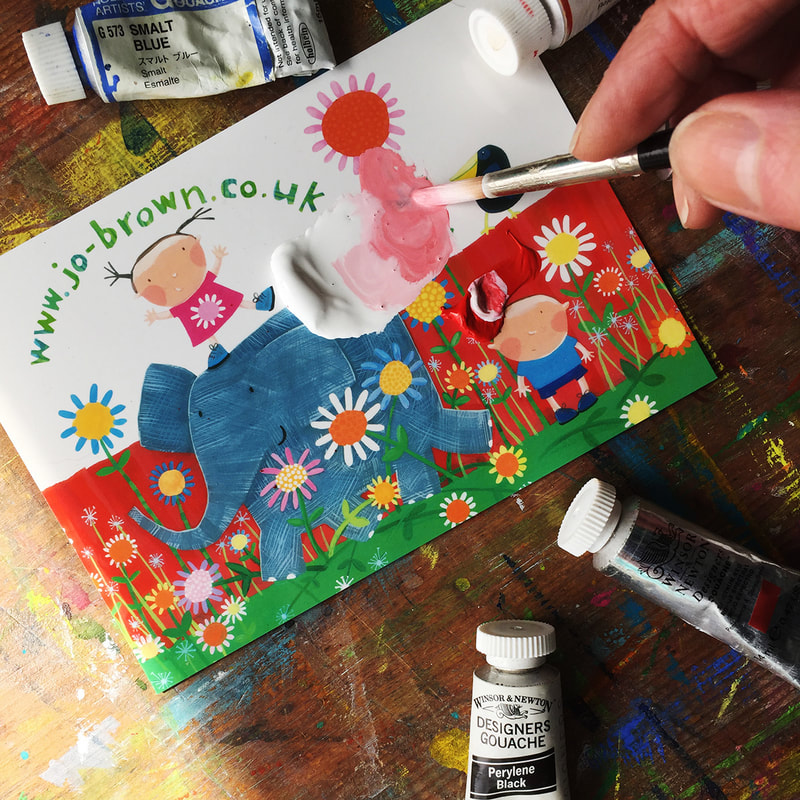
Here are some tips from my years of painting with gouache, that I hope you will find useful. 1.You don't need a fancy paint palette. Squeeze out a little blob of paint onto a shiny surface - a printed postcard, or a plate or a paint palette (plastic or ceramic) wet a brush, a size 6 round brush is good for this, and add a little water to the paint, mix with the brush until it is the consistency of single cream. I love painting on different paper surfaces, it gives a different look and texture to the painted areas, and you can leave some areas unpainted. This article describes working on hand made textured paper.
Novelty Books - Flap books.
Readers Digest Zoo! book with fold out pages. There are lots of different types of children's books, and they require different things. Novelty books have some sort of interactive element - flaps, textures, moving parts such as pop ups or sliders, or fold out pages, to give a surprise element. I have worked lots of books with fold out pages, including this one Zoo! produced for Readers Digest Childrens Books. |
AuthorJo Brown, Illustrator. Archives
November 2025
Categories
All
Want to see which books I recommend?
My affiliate bookshop on bookshop.org is here |